Slots Temple Registration and KYC UK: Account Verification Explained
 Available in GB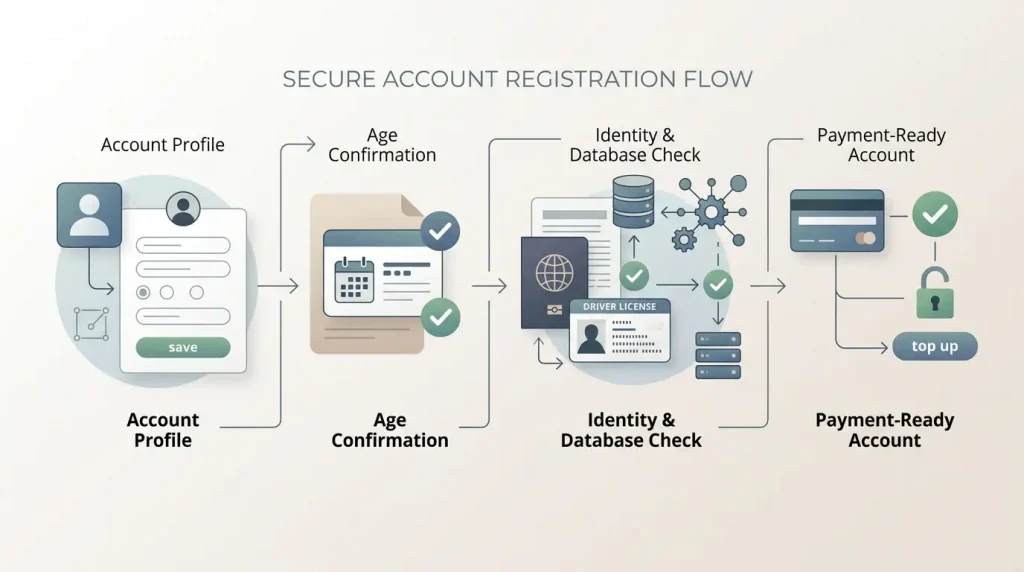
Slots Temple verifies customer identity during registration. Its current UK support page says the automated process uses details such as your name, address and date of birth, checks them against trusted databases, and typically completes in a few seconds. The purpose is to confirm identity and that customers are over 18. The operator describes these as soft checks that do not affect your credit score or appear to other companies.
That does not mean every customer will always finish verification in exactly the same time or that no further information can ever be required. The current public verification information does not publish a fixed document checklist, so any additional evidence should be treated as account-specific. The practical approach is to enter accurate personal details, use your own payment method, and respond to any account-specific request shown by the operator.
Table of Contents
- What happens when you register at Slots Temple?
- How the automated identity check works
- Why Slots Temple checks age and identity at sign-up
- Use registration details that match your real payment setup
- What if verification does not complete immediately?
- Registration and safer-gambling settings belong together
- Mobile registration does not change the verification requirement
- A practical registration sequence
- Limits of the available KYC information
- How KYC affects later account use
- What a "soft" verification check means in practice
- Before depositing: a short account-readiness check
- Frequently asked questions
What happens when you register at Slots Temple?
The first stage is ordinary account creation: you provide the personal information requested by the registration form. Slots Temple’s UK verification guidance specifically identifies name, address and date of birth as information used during its identity checks. Those details are then compared through automated database checks.
The important point is that verification is part of registration rather than something presented only after a withdrawal request. This changes how you should approach sign-up. Enter details exactly as they apply to you, avoid abbreviations or variations that could create a mismatch, and do not treat the registration form as a disposable step that can be corrected later without consequences.
Because the operator uses the information to establish identity and age, inaccurate data can make later account use harder even if the initial form accepts it. The cleanest setup is one where your registration details, payment details and any information later requested by support all describe the same person.
How the automated identity check works
Slots Temple says its registration verification is fully automated and typically takes only a few seconds. The operator says it uses soft checks against trusted databases, including sources such as the electoral roll. It also states that these checks do not affect your credit score and are not visible to other companies.
This is useful because it explains what the normal path looks like without turning a typical time into a promise. A successful automated match can be quick, but “typically” is not the same as a guaranteed completion time for every account. Differences in address history, data matching or other account-specific circumstances can require a different process.
If the automated check does not give the operator what it needs, follow the instructions presented in your account or from support. The current official verification information provides no universal list of required documents, so passports, driving licences, utility bills or bank statements cannot be presented as standard requirements for every account.
Why Slots Temple checks age and identity at sign-up
The operator’s stated purpose is to verify identity and ensure players are over 18. In practical terms, that means the KYC process is not just a payout-stage formality. It is part of the basic account-control process before a customer should assume the account is fully ready for normal use.
A useful distinction separates the verified existence of identity checks from the exact evidence requested for a particular account. Slots Temple checks identity during registration, while document requirements can vary by case and therefore cannot be reduced reliably to one universal checklist from the current public support page.
Use registration details that match your real payment setup
Slots Temple supports UK-issued personal debit cards as a deposit method. That makes consistency between the account holder and the payment setup an important practical consideration. Use your own genuine details and a personal payment method rather than treating the casino account as something that can be shared or funded through unrelated business details.
The payment methods explains the deposit side in more detail, including the current UK payment restrictions. If your main concern is receiving money back out of the account, the separate withdrawal guide covers minimum withdrawal information, processing stages and security checks.
What if verification does not complete immediately?
Start by checking the simple things you control: spelling, date of birth and address data. If your information has recently changed, make sure you are not mixing old and new versions across the account and payment method. Then follow the account or support instructions rather than repeatedly creating new registrations.
Do not assume that a delay proves the account has failed or that a specific document will definitely solve it. The operator’s public article confirms the automated process but does not publish a universal escalation script. If additional evidence is requested, the request shown to you is more reliable than a generic third-party checklist.
It is also sensible to keep copies of messages you receive during an unusual verification issue. That gives you a clearer record if you need to explain what was requested or when you supplied information.
Registration and safer-gambling settings belong together
Opening an account is also the right time to look at control settings rather than waiting for a problem. Slots Temple’s player-protection area provides deposit limits and reality checks, as well as time-out and self-exclusion options. Those tools are covered fully in the safer gambling tools.
The reason to connect the two topics is practical: account setup establishes your identity, while player-protection settings establish how you want the account to behave. Treating both as part of initial setup is more useful than seeing safer-gambling tools only as emergency controls.
Mobile registration does not change the verification requirement
Using a phone does not create a separate no-verification route. The identity check is tied to the customer account, not to whether you register on desktop or mobile. If you prefer to manage the account from a phone, the Slots Temple app explains the current iOS availability and browser access.
The same accuracy rule applies on a small screen: review auto-filled address fields and date entries before submitting them. Convenience is useful only if it does not introduce a data mismatch that later has to be corrected.
A practical registration sequence
- Start with your own details. Use your current legal identity information rather than nicknames or borrowed details.
- Check name, address and date of birth. These are among the data points Slots Temple says it uses for automated verification.
- Allow the automated check to run. The operator says it typically takes a few seconds, but that is not a fixed deadline.
- Respond only to the request actually shown. If extra evidence is needed, use the operator’s account or support instructions instead of assuming a standard document list.
- Set up payments consistently. A UK-issued personal debit card is a supported deposit method; use a payment setup that belongs to you.
- Review player-protection settings. Decide whether a deposit limit or reality check would help before you begin regular play.
Limits of the available KYC information
It does not claim that every customer passes automatically, that verification always finishes within a fixed number of seconds, or that Slots Temple has one universal list of documents for everyone. Those statements would go beyond the official support material rechecked on 28 September 2026.
Slots Temple documents identity verification as part of registration, which directly contradicts descriptions of the site as a no-KYC casino. If a website or forum presents a shortcut that contradicts the account process shown by the operator, the operator’s current instructions should take priority.
How KYC affects later account use
Verification is easier to deal with when it is completed as an account-setup task rather than left as an unresolved issue. Payment activity, account changes and withdrawals can all create situations where accurate customer data matters. Keeping one consistent identity record reduces avoidable friction.
For withdrawals specifically, account and payment checks are distinct from the time your bank or payment route may take after approval. The withdrawal times and checks guide separates account verification from payment processing because they are distinct stages.
For the broader picture of the operator, games, payments, mobile access and regulation, return to the full Slots Temple review.
What a “soft” verification check means in practice
Slots Temple’s own description is useful because it separates identity verification from a credit application. The operator says the check is made against trusted databases and does not affect your credit score. That means the normal registration check should not be interpreted as borrowing money, applying for finance or creating a visible credit search for other companies to see.
For the customer, the practical job is still to give information that can be matched. A database check can only compare the data entered with the data available to it. If a registration form contains a typo, an old address or inconsistent personal information, correcting the account details through the operator is more sensible than trying to guess which external record is causing the mismatch.
This is also why images from other users are a poor substitute for your own account instructions. Verification is tied to the individual record being checked. The verified public facts describe the normal process, while any additional request should be treated as specific to the account receiving it.
Before depositing: a short account-readiness check
Once registration is complete, take a moment to confirm that the account information still looks correct before adding money. Check the spelling of your name, the address shown on the account and the payment method you intend to use. Slots Temple supports a UK-issued personal debit card, so the payment stage should be approached as part of the same identity-consistent setup rather than as a separate anonymous transaction.
Also review the player-protection settings before the first regular deposit. A deposit limit can be set independently of whether the registration check was quick, and a reality check can be useful regardless of how much you plan to deposit. Registration answers the question “who owns this account?”; player-protection settings answer a different question: “what boundaries should apply while this account is being used?”
Frequently asked questions
Does Slots Temple verify identity when I register?
Yes. Its UK support page says identity verification is carried out during registration using information including name, address and date of birth.
How long does Slots Temple verification take?
The current official support page says the automated check typically takes a few seconds. That is a typical description, not a guaranteed maximum for every customer.
Which KYC documents does Slots Temple require?
The current public verification information does not provide a universal document checklist. If additional evidence is requested, follow the specific instructions shown in your account or provided by support.
Does the verification check affect my credit score?
Slots Temple describes its database checks as soft checks that leave the credit score unaffected and are not visible to other companies.
Can I register on mobile without verification?
No separate no-verification route is documented. Verification applies to the customer account whether you use mobile or desktop access.